
Caring for the People We Love: Why Family Caregiving Needs a Better Daily Rhythm
More than 53 million Americans quietly carry the everyday work of caregiving — calls, notes, reminders, observations, and family updates. Here is why the next layer of caregiving support has to start with the caregiver, and how Resolve Reinvent’s Care Circle™ was built for the daily rhythm of real families.
At some point, almost every family becomes a care team.
Sometimes it happens suddenly: a fall, a hospital visit, a new diagnosis, a parent who can no longer live fully independently. Other times it happens slowly. Mom starts repeating herself. Dad stops driving at night. A spouse is recovering from surgery. A sibling is struggling with depression. A college-age child seems withdrawn. A friend becomes chosen family and needs someone to check in.
Caregiving rarely begins with a formal title. Most people do not wake up one morning and say, “I am now a caregiver.” They just start doing the work.
They call. They text. They remind. They drive. They listen. They remember medications, appointments, moods, symptoms, conversations, meals, falls, fears, bills, and questions for the doctor.
And quietly, the weight builds.
Caregiving is already part of American life
Caregiving is not a niche issue. It is one of the most common and under-recognized responsibilities in modern life.
The CDC describes caregiving as an essential public health issue, noting that more than 53 million unpaid caregivers support friends and loved ones who are older, chronically ill, or living with disabilities.
The CDC also reports that about one in five U.S. adults provides care to a family member or friend with a chronic health condition or disability. In its 2024 analysis, the CDC found that caregivers had worse outcomes than non-caregivers on most health indicators measured.
And the need for care increases with age. According to the Administration for Community Living, someone turning 65 today has almost a 70% chance of needing some type of long-term care services or supports during the rest of their life. On average, women need care longer than men, and about 20% of today's 65-year-olds will need care for longer than five years.
That means caregiving is not just something “other families” deal with. It is something many of us will either provide, receive, or coordinate.
Most care still happens at home
When people imagine elder care, they often picture nursing homes or assisted living facilities. But much of the actual day-to-day support happens at home, through family, friends, spouses, adult children, and neighbors.
The Administration for Community Living reports that more people use long-term care services at home than in facilities, and that unpaid care is a major part of that support.
Dementia care shows the same pattern. The CDC says about 80% of adults with Alzheimer's disease and related dementias receive care in their homes, and more than 11 million U.S. adults provide unpaid care for someone with dementia. In 2023, those caregivers provided about 18.4 billion hours of care.
For many families, “care” does not look like a formal care plan. It looks like this:
- A daughter calls every night at 7 p.m. to see if Mom ate dinner.
- A son keeps notes after every doctor visit because his siblings live out of state.
- A spouse watches for mood changes after a hard medical diagnosis.
- A sister checks whether Dad is taking his medication correctly.
- A friend notices that someone who used to be social has stopped answering texts.
That work matters. But it is often scattered across text threads, voicemails, half-remembered conversations, sticky notes, and one exhausted person's memory.
The caregiver carries the invisible load
The hardest part of caregiving is not always the physical task. Sometimes it is the mental load.
It is remembering what changed.
It is knowing who was told.
It is trying to explain three weeks of small observations in a five-minute doctor appointment.
It is wondering whether something is serious or just a bad day.
It is feeling guilty when you miss a check-in.
It is carrying the whole family's concern while everyone else says, “Just keep us posted.”
Caregiving can be deeply meaningful, but it can also be emotionally draining. The CDC notes that caregiving can be rewarding while also being hard on the caregiver's health, and that dementia caregivers are at greater risk for anxiety, depression, and poorer quality of life than other caregivers.
That is why the future of caregiving support cannot only be about medical services. Families also need better ways to organize the everyday reality of care.
Current caregiving resources are helpful — but fragmented
There are important resources available today.
The Eldercare Locator, a public service of the Administration for Community Living, helps connect older adults and families with local services. Families can search by location, call, text, chat online, or email trained staff for help finding support.
Medicare may cover certain home health services for eligible people, including skilled nursing, therapy services, medical social services, patient and caregiver education, and some part-time or intermittent home health aide care when conditions are met.
Medicare also covers caregiver training services under certain conditions, including training on medication support, daily tasks, safe movement, communication, understanding medical conditions, emotional support, and preventing infections or wounds.
These resources matter. Families should know they exist.
But there is still a gap.
Most resources help after a need is identified, after a provider is involved, or after the family knows what to ask for. What many caregivers need is help with the daily in-between: the check-ins, the notes, the family updates, the patterns, the emotional load, and the small observations that become important over time.
That is the space where Resolve Reinvent created Care Circle™.
Why we built Care Circle inside Resolve Reinvent
We designed Care Circle for the person doing the caring.
Not because they are a clinician. Not because they want another complicated system. And not because their loved one wants to download an app, create an account, learn new technology, or track everything themselves.
In many families, the loved one being cared for does not want more technology. An elderly parent may not want an app. A spouse recovering from illness may not want to “log” their feelings. A loved one struggling with mental health may not want one more thing to manage.
So Care Circle starts with the caregiver.
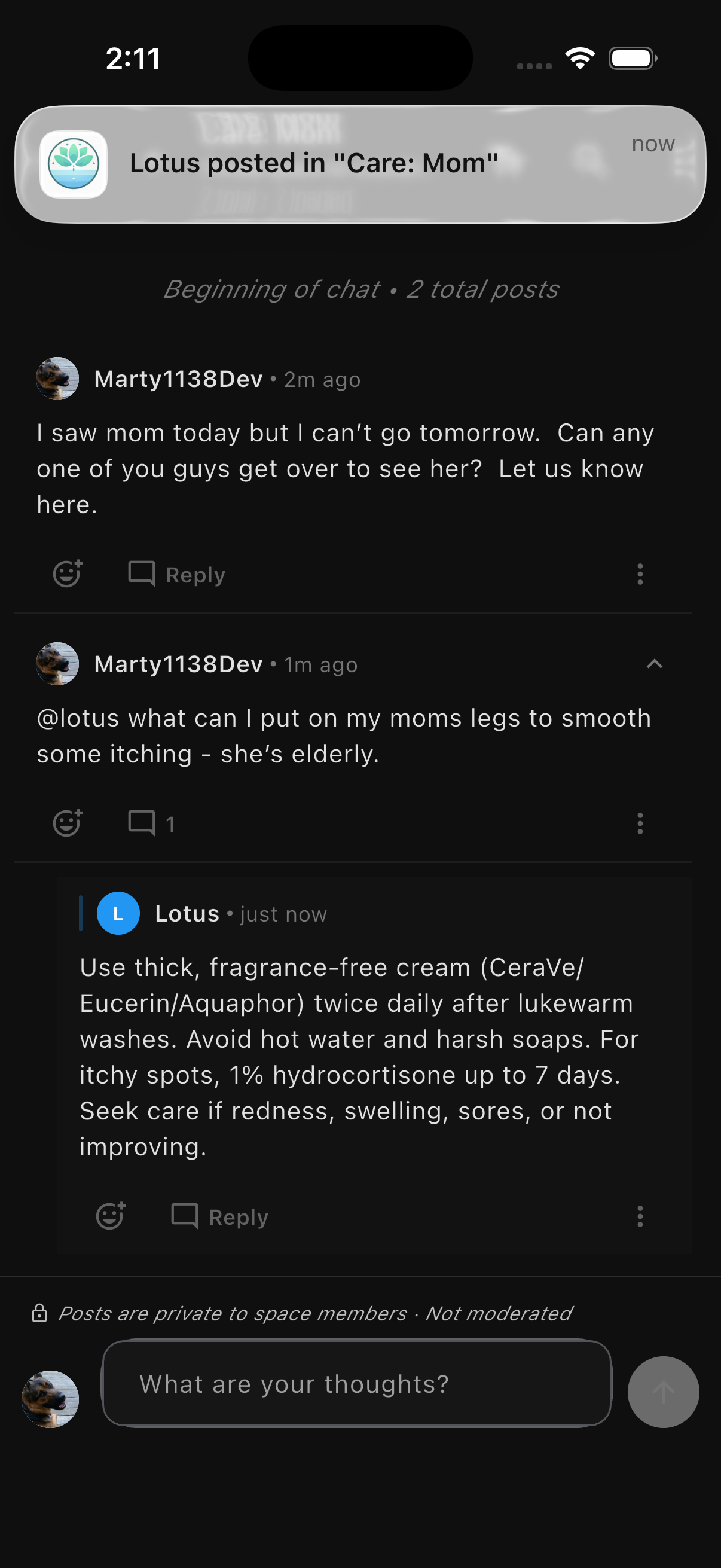
Inside Resolve Reinvent, a caregiver can create a private circle for someone they love. They can set daily check-in reminders, capture notes after calls or visits, use voice journaling to record what happened, and keep a private timeline of how that person is doing.
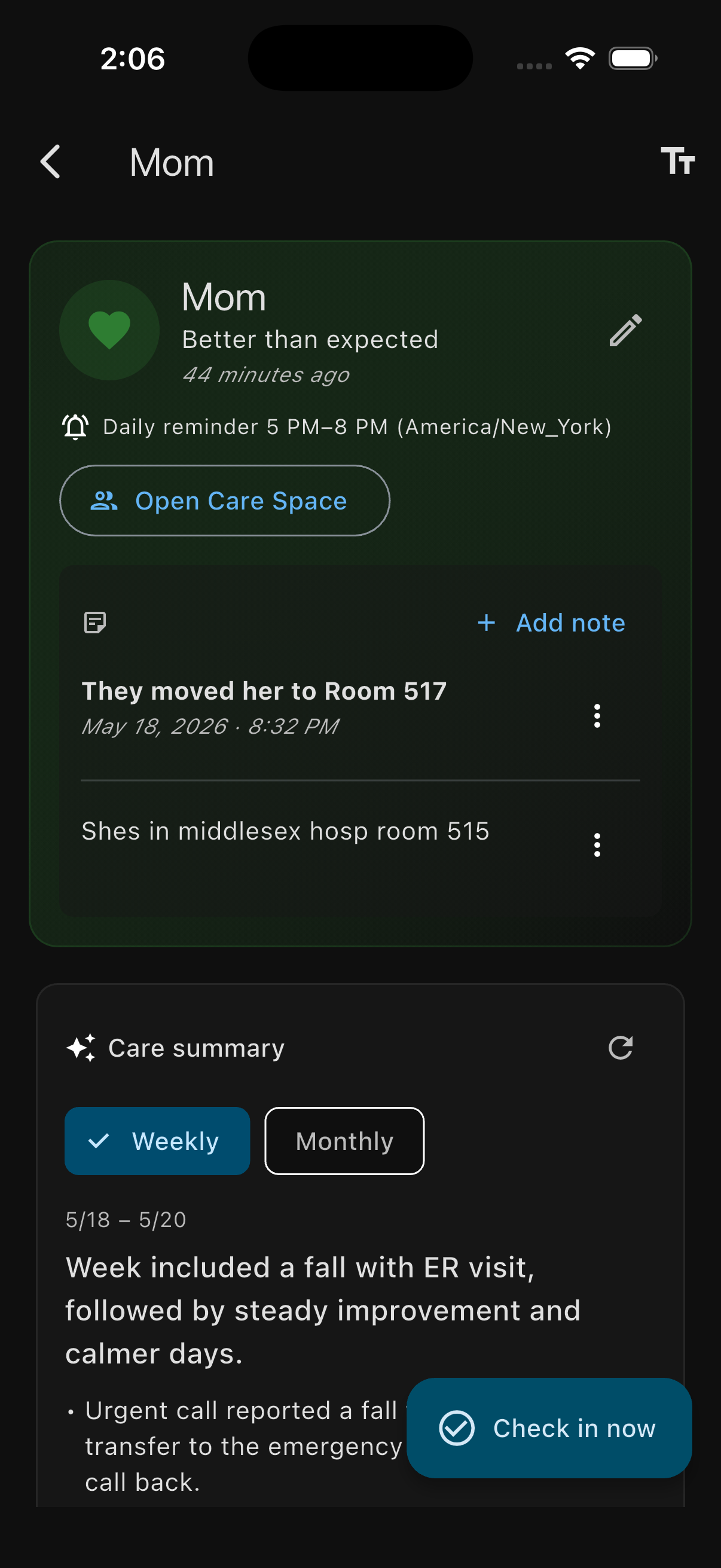
Care Circle is designed to make caregiving less scattered.
A caregiver can track:
- how Mom sounded today
- whether Dad ate, slept, or seemed confused
- what happened at the appointment
- what room someone was moved to
- what questions need to be asked next
- whether mood, pain, anxiety, memory, or energy seems to be changing
- what siblings or family members need to know
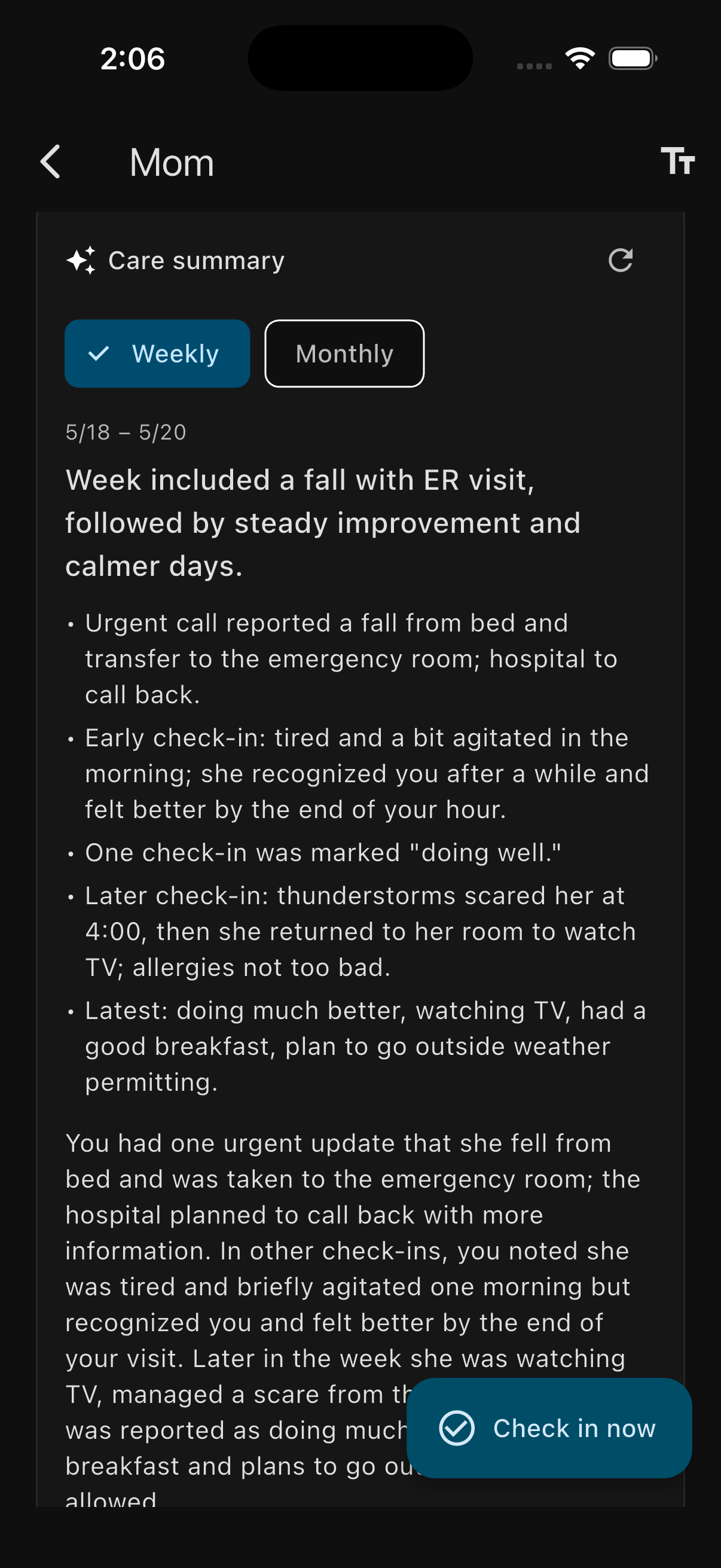
Care Circle also gives families a private space to share updates, so caregiving does not have to live in one chaotic group text or one person's memory.
AI should reduce the burden, not replace the human care
Caregiving is human. It is relational. It depends on love, trust, attention, and judgment.
AI should not replace that.
But AI can help with the burden around caregiving.
Resolve Reinvent's AI companion, Lotus, can help summarize check-ins, organize caregiver notes, surface patterns, and help caregivers think through what to ask next. On the Care Circle page, Resolve describes this as AI that “keeps the picture together” so the caregiver does not have to carry everything alone.
That is the point.
Not diagnosis. Not clinical replacement. Not emergency response.
Just support for the daily work of noticing, remembering, reflecting, and communicating.
Care Circle is also for mental health support
Caregiving is not only elder care.
Sometimes the person you are caring for is a young adult having a hard time. A spouse managing anxiety. A sibling in recovery. A friend navigating grief. A parent dealing with depression. A family member who does not need a hospital but clearly needs someone paying attention.
Care Circle can support those situations too.
A caregiver can check in, journal privately, create a private family space, and notice emotional patterns over time. The loved one does not have to use the app for the caregiver to use Care Circle as a reflection and organization tool. Resolve's Care Circle FAQ states that the loved one does not need the app; the caregiver can track and reflect without requiring the loved one to have an account.
That matters because real care has to fit real people. The best tool is the one that drops into the caregiver's life without creating another burden.
The caregiver needs care too
One of the biggest mistakes in caregiving tools is that they focus entirely on the person receiving care.
But the caregiver is part of the care system.
Care Circle was built inside Resolve Reinvent because the caregiver also needs support: mood tracking, breathing tools, private reflection, journaling, recovery support, sleep soundscapes, and AI-guided reflection are all part of the broader app experience. Resolve describes Care Circle as being connected to the rest of Resolve so “the caregiver gets cared for, too.”
That is not a nice-to-have. It is essential.
A burned-out caregiver cannot keep showing up well forever. A caregiver who has no place to put their own stress eventually becomes part of the crisis.
Care Circle helps caregivers create rhythm:
- Check in.
- Capture what happened.
- Share what matters.
- Notice patterns.
- Ask better questions.
- Take a breath.
- Keep going.
A private circle for the people who matter most
Privacy is central to caregiving. Families are often dealing with sensitive health, emotional, and personal information.
Care Circle is invite-only. Resolve states that what users capture about loved ones stays in the private circle, is not posted publicly, is not shared with third parties, and is not used to train AI. Users decide who is in the circle and what they can see.
That privacy-first design matters because caregiving requires trust.
Families need a calm place to coordinate, not a public feed. They need private updates, not another noisy social network. They need shared awareness without exposing the person they love.
Caregiving was never meant to be a solo job
The next generation of caregiving will not be solved by one app, one provider, one family member, or one government program. Families need all of it: local resources, professional support, Medicare-covered services when eligible, community programs, respite, caregiver training, and better tools for everyday coordination.
Resolve Reinvent is focused on that everyday layer.
Care Circle helps caregivers stay connected to loved ones through daily check-ins, private notes, voice journaling, family spaces, AI-powered summaries, and community caregiver support. It was designed for the real caregiver: the person trying to do the right thing while working, parenting, managing their own life, and worrying about someone they love.
Caregiving begins with love.
But love still needs structure.
That is why we built Care Circle.
A private place to care for the people you love — without carrying it all alone.
A look inside Care Circle
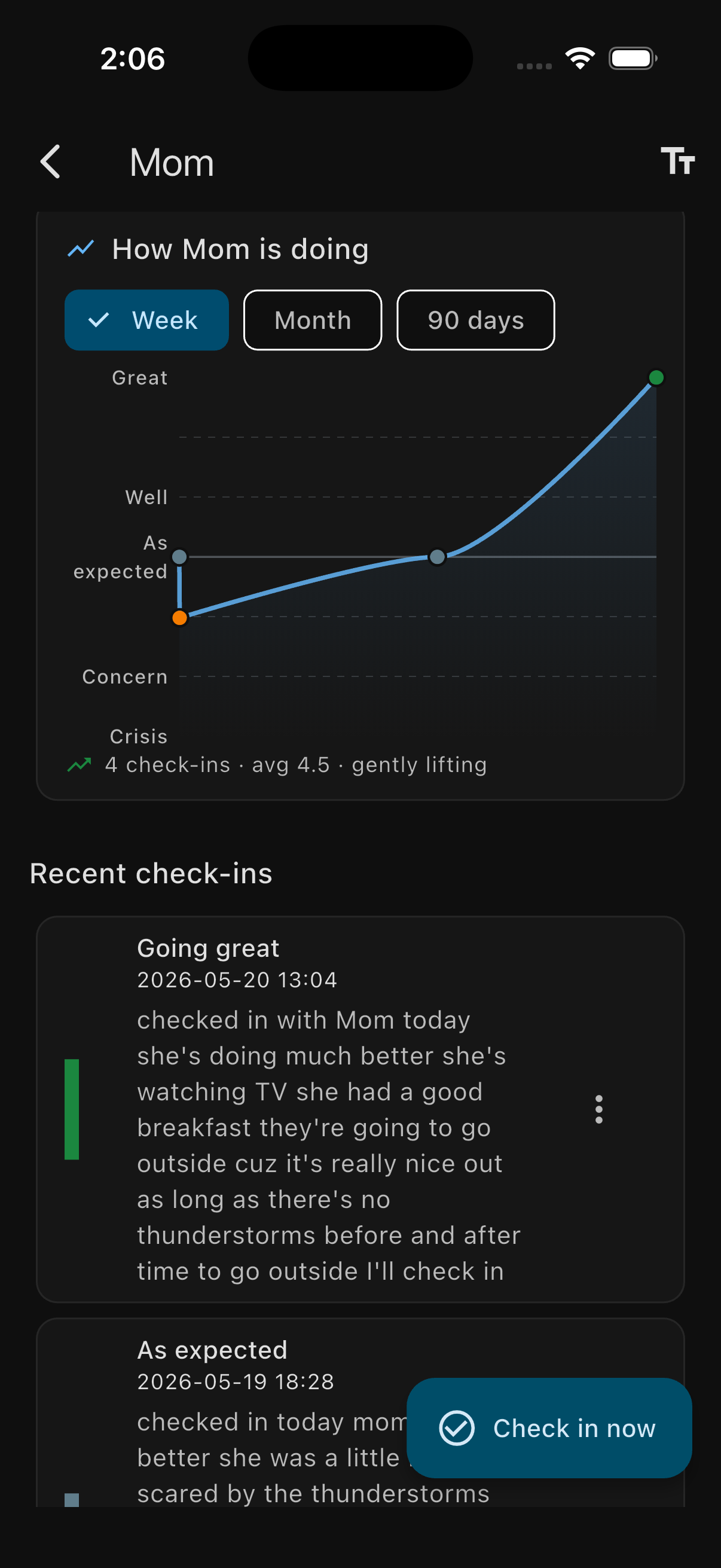
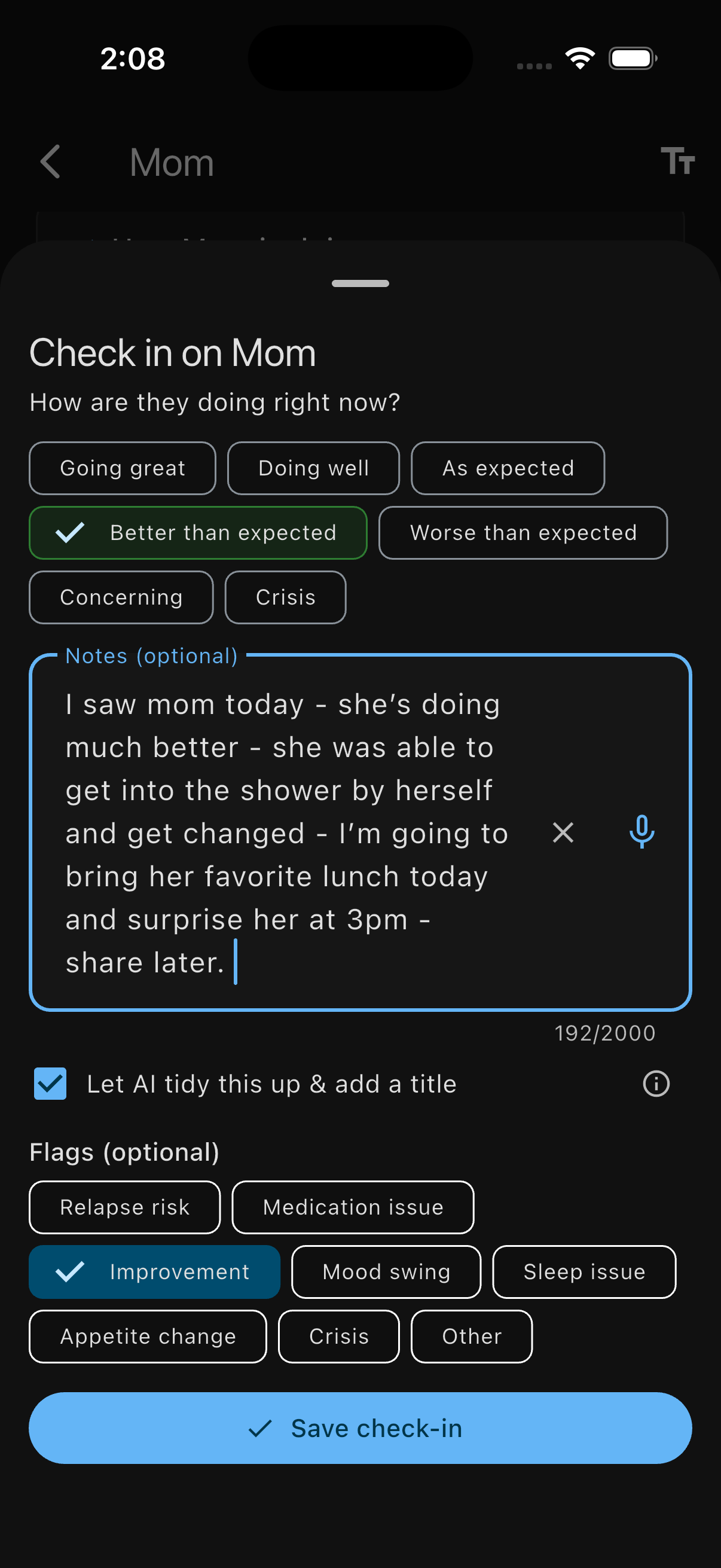
Tap any image to enlarge.
Sources & Further Reading
- CDC — Dementia Caregiving as a Public Health Strategy. cdc.gov — caregiving as a public health issue; 53+ million unpaid caregivers.
- CDC MMWR — Changes in Health Indicators Among Caregivers, United States, 2015–2016 to 2021–2022. cdc.gov/mmwr — one in five U.S. adults are caregivers; caregiver health indicators.
- Administration for Community Living — How Much Care Will You Need? acl.gov — ~70% of people turning 65 will need long-term care; home vs. facility care.
- CDC — Caregivers of a Person with Alzheimer's Disease or a Related Dementia. cdc.gov — 80% of people with Alzheimer's/dementia cared for at home; 11M+ dementia caregivers; 18.4B hours of care.
- Medicare — Home Health Services Coverage. medicare.gov — what Medicare-covered home health services may include.
- Medicare — Caregiver Training Services. medicare.gov — Part B caregiver training coverage and examples.
- Eldercare Locator (Administration for Community Living). eldercare.acl.gov — public service connecting older adults and families to local services.
- Resolve Reinvent — Care Circle. getresolveai.app/care-circle — product page for Care Circle, including privacy and FAQ details.
Topics
- #Caregiving
- #FamilyCaregivers
- #FamilyWellness
- #ElderCare
- #Dementia
- #Alzheimers
- #AgingParents
- #LongTermCare
- #MentalHealth
- #BehavioralHealth
- #Wellness
- #Recovery
- #CaregiverSupport
- #CaregiverBurnout
- #Respite
- #CareCircle
- #CareCoordination
- #PrivateFamilySpace
- #AIAssistedSelfHelp
- #AI
- #Lotus
- #DigitalHealth
- #CDC
- #ACL
- #Medicare
- #EldercareLocator
- #Resolve
- #ResolveReinvent
Caring for someone you love? Start a private Care Circle inside Resolve Reinvent.
Try Resolve Reinvent Learn about Care Circle